Today is our sixth day in London. Well-rested, we woke up feeling fresh and ready for the day's activities.
One of the things I was looking forward to for the London trip was visiting the British Library, and today we were attending a workshop and exhibit entitled “Georgians Revealed: Life, Style and the Making of Modern Britain”.
 |
| A very interesting optical illusion display found at the British Library |
While Singapore's libraries are nothing to scoff at, the grandeur and immensity of the library was truly a sight to behold. There, we met our guide, Irene, and she took us through the exhibit and provided us in-depth information about Georgian society. Information about the Georgian era is of great significance to us as it is the period in which Jane Austen (author of Mansfield Park, the text we are currently reading in school) lived and wrote. The workshop therefore gave us insight into the daily lives of those who lived in the Georgian age, particularly in terms of leisure and fashion. Before the workshop, I never fully comprehended the significance of historical context in shaping a novel. During the workshop, however, I discovered that making links between the social context and the novel was a very enjoyable and deeply enhanced my understanding of Mansfield Park. For instance, there was a sharp increase in printing which led to a proliferation of ideas to all levels of society. The publishing of magazines and newspapers resulted in people being subject to greater public scrutiny. This increased the importance of keeping up with appearances and enhancing one’s reputation. People therefore made it a point to keep up with the latest fashion trends, lavishly decorate their homes and gardens, learnt musical instruments and dancing, and discuss fashionable topics such as landscaping, in order to be perceived as sophisticated and cultured. These insights into Georgian society are relevant to Mansfield Park, as Austen heavily criticized society's emphasis on such superficialities throughout the novel. Irene also reiterated how manners were simply a matter of style, rather than founded on sincerity and moral conscience, which was directly applicable to the novel as well. All in all, I found the exhibit and workshop a very fruitful experience.
We then went to King's Cross station to have lunch and took photos of the famous 9 3/4 platform, made famous by the Harry Potter films. We were provided free Hogwarts scarves to wear and pose at the trolley of luggage half disappearing into the wall. For a few seconds, we were allowed to imagine that we were actually on our way to board the Hogwarts Express.
After that, we met our second guide for the day, Colin. He took us on the Charles Dickens' walk, where he showed us Dickens' homes and various locations in London which served as settings for novels such as Oliver Twist and Bleak House.
Throughout the walk, Colin regaled us with excerpts from Dickens' stories and Dickens’ childhood and personal history. For instance, we were told an entertaining account of how Dickens’ readers eagerly anticipated the next instalment of The Old Curiosity Shop in 1841, as his fiction was serialised. Following a cliff-hanger that left readers wondering if little Nell had passed away, American fans anxiously stood at the harbour in New York, awaiting the ship transporting novel’s last instalment. Unable to contain their curiosity, they shouted across to the shipmates, “Is little Nell dead?”, only to be receive the sobering reply, “Yes, Nell is dead!”.
Overall, I was struck by how Dickens' difficult childhood – his father’s imprisonment at the Marshalsea Debtor’s Prison and being sent to work at the Warren’s Blacking Factory at a tender age of 11 – shaped his writing. His novels, for instance, consistently depicted orphans, poverty, and injustices of the legal system.
The walk ended at the Charles Dickens House Museum, which is a detailed replica of Dickens' actual home at 48 Doughty Street.
 |
| The famous Sitting room |
It fascinated me not only because I have a personal interest in the Victoria era, but walking through the four storeys of the house allowed me to have an intimate look at a typical Victorian home and Charles Dickens’ way of life. I confess to not having read much of his books. In fact, I have only read A Christmas Carol. After this walk however, I have a greater interest in his works and look forward to reading Oliver Twist and David Copperfield in particular.

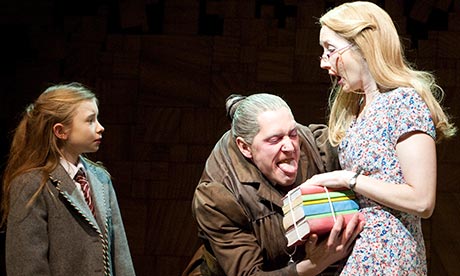
Our last and final stop for the day was the musical Matilda, something many of us were greatly looking forward to. I have been a fan of Roald Dahl's work ever since I was young, having read novels such as George's Marvelous Medicine, The Witches, The Twits and so on. Therefore, this musical was the highlight of my day. In my opinion, Matilda was very well-executed and innovative play. The excellent cast, together with its intricately designed stage and elaborate props, such as the blackboard on which Matilda “writes” with her telekinetic powers, made the musical truly enjoyable and memorable. The impressive, elaborate choreography and superb stage effects also contributed to a thoroughly engaging experience.
 |
| The Matilda stage set |
I especially liked how the actor portrayed the character and absolute tyranny of the main antagonist, Mrs Trunchbull. It was both comically accurate and hilarious.
All in all, the musical succeeded in capturing the whimsy and irreverence of Roald Dahl’s novel.
Written by Sonya, 13S15



No comments:
Post a Comment