Who are we?

Sunday, 24 November 2013

Day 9, 24th November

Farewell, London

We awoke on Sunday morning muddled with feelings of anxiety, excitement and dread all at the same time. This being the last day of our Literature Enrichment Trip, we were anxious about making the most of our last few hours in London and not just to adorn our social networking sites with photos. The past 9 days have been filled with enjoyable and educational adventures, and so it felt only right to end with an equally memorable day.

Everything is a lot more precious when you know it is going to be taken away soon and so, I filled myself up to my satisfaction during breakfast – scrambled eggs, toast, cereal, juice. However, having had stayed up all night packing our bags, chatting with roommates and neighboring trip mates, all of us were knocked out the minute we  loaded up the coach with our luggage, and sat down.

“Wake up, Saints!”, Mr. Chee Kam’s voice could not have been louder as it jolted all of us out of our deep slumber. Dazed, we took our valuables and got off the bus towards the Imperial War Museum. The chilly, harsh breeze that greeted us snapped us out of our daze and we took in our surroundings – a brown building with an impressive glass dome, in front of it stood 2 majestic-looking canons surrounded by bushes and a field blanketed with dried leaves.

Seeing that we were early and the museum was not opened yet, our teachers granted us free time to frolic about and off we strolled, breathing in the fresh morning air, and jumping over the fence separating the field from the museum. And there, it was as though the 7-year-olds within us were immediately unleashed upon taking in the picturesque view of the trees, brick-walled buildings, open fields, with the sunlight illuminating the greenery and falling leaves. Immediately more energized than a lifetime supply of caffeine could make us, a few of us ran to the playground and started fighting for the swings, some started gathering up dried leaves to dive into while others mingled to enjoy and capture the beauty of the Sunday morning on their cameras. The air was filled with laughter and joy, every one of us simply enjoying each other’s company and that of Mother Nature.

When it was time to go in, we rounded up with a group picture – a final memento of our last morning in London well spent – and jogged to the side entrance of the museum. During the hour that we were given time to venture through the Holocaust Exhibit, and embark on a journey into the past. We imagined the helplessness and sorrows of the Holocaust victims and found that no amount of empathy could measure up to the true extent of their sufferings. I personally feel that what fully captured their suffering were not the many vivid descriptions of their punishments, not even the aisles of photographs of the skin and bones that were the victims. Rather it was their personal belongings – the only remnants of a being in a glass case – that captured a life snatched away by the Nazis. Such remnants included spectacles, a glass lens, a pen, letters. There was a particular letter written by Adrien Josef Cerf to his wife while he was on the train to Auschwitz, the largest of the death camps, that touched me the most. The letter ended off with “All my thoughts and all my love are in this last letter, together with my gentle tender kisses.” This made me realize that during the duration of time where the Nazis were in power in the 1940s, not only lives were lost, but relationships, and love.

This realization opened my eyes to the fact that we take a lot of things for granted. We sleep on comfortable beds, we are sheltered, warm and comfortable, we eat enough to last the day, we are not burdened with hard physical labor, we wake up early to be educated and yet, we – even I – complain. The war prisoners slept crowded together in poorly ventilated rooms, they are awoke before dawn, they witness hideous punishments, they are forced to endure brutal physical labour and are only given watery soup or a piece of bread each day. Need our privileges be taken away; need we be put through extreme suffering, before we realize that we have a lot more to be thankful for?

Edmund Burke (1729-1979) said, “For evil to triumph, it is only necessary for good men to do nothing.” The true meaning of this quote was manifested as we learnt about the people who helped the prisoners, one of them was a Swiss diplomat named Charles Lutz who aided 200 Jewish children reach Palestine despite the risk of facing dire consequences. Learning this, I realized that no matter how insignificant we deem ourselves to be, be it in terms of education achievements or social position, there is always a definite way of making a difference in people’s lives – compassion.

Our visit to the museum ended too soon as we returned to the coach, ready to visit Tate Britain, an art museum that housed paintings by William Blake, Joseph Mallord William Turner and John Constable and many more. Mr. Chee Kam walked us through the JMW Turner gallery where we were mesmerized by Turner’s excessive use of contrasting colours to evoke certain feelings and messages.  My personal favourite painting of his would be “Interior of a Great House: The Drawing Room”. Upon first sight, it is difficult to make out what the painting was about but the bold oranges and reds indicate the presence of a fire. The intensity of the fire can be seen through the contrast between the all-consuming red and the lighter colours that evoked a sense of calmness. Also, while the wreckage of the room was painted with harsh strokes and dabs of dark paint, the parts of the room left unscathed were painted with gentle, continuous strokes of white and yellow. I feel that the painting is a representation of calm in the midst of chaos, which really spoke to me because the past year has been a year of challenges for me and so the painting reminded of the times in which I had managed to keep faith and focus on the good in life, rather than what had been lost along the way.

Although I have the artistic skills of a duck, I have always been appreciative of artists who have been able to change the world with their masterpieces. As a viewer, I think an artist could do that by connecting with the viewers through their painting. When I laid eyes of “Fen Lane, East Bergholt”, a painting by John Constable that depicted a view of Fen Lane that he valued as a child, I immediately felt a personal connection with the painting and Constable himself. I feel that when an artist transforms a precious childhood memory, or any memory, into oil on a canvas, he places a part of himself on canvas as well and I feel myself relating with his childhood. I imagined myself walking along the same Fen Lane as a boy, excited for school and yet strolling slowly just to take in the view and this is why this painting quickly landed itself as one of my favourites.

After an hour of browsing through the various galleries in Tate Britain, we boarded the coach again for our last lunch in London at Leicester Square. My friends – Afifah, Tessa, Sonya, Andy and Raymond – and I had delicious lamb and chicken kebabs and pizzas for a filling lunch. Finally, weary and more than ready to head back to the warmth of Sunny Singapore and satisfy our cravings for Asian food, we made our way to the airport.


As much as I had enjoyed my first trip to London – it was also my first time on an airplane – and the fact that it was a Literature-based trip made it all the more one of the best experiences of my life. Aside from the many, many souvenirs taking up half my luggage space, I also bring back with me my precious life lessons and valuable friendships. Though London was undoubtedly a blast, there is no place quite like home, and definitely no food quite like Asian food.

- Nadia 

Saturday, 23 November 2013

Day 8, 23rd November, London


We had an early start, taking the Tube all the way to Brixton. The presentation prior to leaving had prepared me for a ghetto where we needed to be extra careful. In the daylight, this proved to be untrue. Though Brixton's somewhat tumultous history was filled with racial riots and tensions between the multi-national residents and the police force, it seemed rather serene in reality. There were plenty of beautifully designed houses and stores in the vicinity. We also discovered a skate park known somewhat affectionately by locals as "Brixton Beach", a supervision-free space, where people could skateboard, ride a mountain bike and paint graffiti, so long as it was done within the designated space. Despite being a limited area, the idea of giving residents free reign to do as they please is extremely fresh. This is ever more applicable to students like me who, honestly speaking, live in a well-regulated environment, confined by a culture of fear.


Apart from the houses, another key part of the town was the Brixton Academy, a famed rock concert venue. Our Blue Badge tour guide, Janet, said that David Bowie (who was actually born in Brixton before moving away at age 6), the Rolling Stones and other such famous rock bands had named it one of their favourite performance venues. The Academy was an unexpected feature as Brixton is relatively out of the way. To me, that just goes to show how strong the culture of Arts here is. Despite Brixton being far away from Central London, there is still a performance venue. I think this is where Singapore can take lessons from Britain as the government is working to expand our Arts sector. They should build art venues close to the residential areas that so that Art can be accessible.


After the tour, we headed to Brixton market to find street food and other small shops. While waiting for Jeff the Chef, to set up the recommended Jamaican jerk chicken stall, we set off in our groups to explore. My group headed to Brixton Village. The effects of gentrification can be seen there, as a dichotomy between the types of shops there gave us a stark contrast. Firstly, there are swanky cafes that sell crepes and boutiques where a porcelain cups go for 48 pounds apiece. Then, there are produce and sundry shops that cater to lower families of various ethnic backgrounds. These shops that have two different sets of clientele are crammed into one space.


As Mrs Wee pointed out, this raised the question of how the latter groups can afford rental, if the up market shops are moving in and pushing prices upwards. How long can they sustain themselves? This put the issues of gentrification into perspective, as we could experience first-hand the divide. Mrs Wee also pointed out a shop, Foxton, which apparently had become synonymous with gentrification today. When a Foxton store opens, property prices in the vicinity skyrocket. I feel that this is applicable to Singapore as well, where the widening income gap is being increasingly brought up as a key concern. Places like Tiong Bahru have been gentrified as well. The swanky new shops in that area made rental unaffordable to those who run traditional businesses that sell snacks. It made me think about the price of progress, whether we can only climb up at the expense of others. Admittedly, I still cannot formulate a satisfactory answer, but I suppose reflection is the first step. We then proceeded to enjoy the jerk chicken, courtesy of Mr Chee Kam, and the hawkers were kind enough to give us a portion of fried corn bread fritters, called "Festival". It is said that the name comes from the joy of eating the dish, a similar feeling to being at a festival.


Apart from being a day of exposure, today was also a day of eating. After sharing the jerk chicken and festival, we headed to Borough Market for lunch. Before we boarded the Tube, our tour manager Angela kept telling us "Green Park, gray line, London Bridge", until we were repeating to ourselves like a mantra. We were taking the Jubilee Line, which was new to us, so it was reassuring that I had memorised both the stops and the line.


 I gained a greater appreciation for Singapore's environment and what it has to offer when Angela told us on the Tube that every weekend, a line of the Tube is closed for maintenance, and on Christmas day, there is absolutely no public transport. In Singapore there are plenty of complaints when there are delays, or if rush hour squeezes us too much. Through being here, I've learnt to be more appreciative, and discovered the true meaning of rush hour!

Borough Market
At Borough Market we once again split up, accompanied by our teachers. All of us were extra watchful, as it was extremely crowded. I was in the group with Mr Chee Kam, and together we sampled and shared dishes. These included paella, pork belly and beef sandwiches from the famed Roast, and an array of desserts. At the end of our little exploration, all of us were thoroughly satiated, some barely able to walk, including me! I was amazed at both the variety and the size of the serving. I was thankful that I could split the food amongst my fellow group members.

From there, we proceeded to Westminster Abbey for Evensong, a full church service that is mostly sung by their esteemed choir. The entire affair was extremely solemn. They seemed to stand on ceremony more than we do in Singapore, from my limited experience. There were a set of steps that we had to follow throughout the service. The choir indeed sang beautifully. However, it was difficult to follow the words as I was not very used to the choral singing. I often missed the cue to stand or sit. All the same, it was still an unforgettable and new experience.


We were scheduled for an early dinner, but had a little extra time before that. That enabled us to have some extra shopping time at Covent Garden. We split up into smaller groups in order to navigate through the large crowds. My group went to Jubilee Market, near our meeting point, as things there were supposedly cheaper. After spending some time hovering around stalls and making purchases, we assembled to head to Browns for our dinner. Dinner was pretty grand, and all the food was extremely rich, further filling our stomachs to the brim.


Later, we met with some of our SAJC alumni here in London, and they were able to share their experiences here with us. We interacted a lot with them to find out about college life here and how they adjusted. Honestly, I expected it to be pretty boring, like a seminar-type session. On the contrary, because we were split into small groups, I was able to learn a great deal from them and hear about their experiences and sharing our own.


Written by Andrea Tan, 13A02

Friday, 22 November 2013

Day 7, 22nd November, London: Gumley House Convent, V&A Museum, Standard Balti House

At the break of dawn, we left the Stratford Travelodge in our coach for one of the greenest sixth form campuses in London. This fresh campus belongs to Gumley House Convent School, where we visited for a day of cultural exchange with English students of our age.

During the one hour coach ride, Mr. Chee Kam provided a crash course on how to properly appreciate and critique the plays we watched over the past days. My takeaway is a 3 step guide on how to achieve this - by analyzing the plays' set, costume and lighting.

Upon arrival, we were warmly welcomed by Gumley House's staff, the Assistant Head Teacher Mrs. Windmill, Director of Specialisms Ms. Roberts, as well as their Head Teacher, Mrs. Kolczynska. Mrs. Windmill began our day by introducing to us their school's culture, curriculum and various activities they have been participating in. From her presentation, we learnt that the 172-year-old Gumley House has been actively involved in international conferences such as the Women of the World Festival (WOW) and has also hosted their own conferences such as the Globalization Conference 2013 to prepare their students for the changing needs of today's society.

Following that, the moment we were waiting for arrived. We were finally given an opportunity to interact with the sixth form students of Gumley House Convent. Our group of Saints were split up into two separate groups to attend either a Sociology or Geography class. In the Sociology class, we were all made to rank the importance of our different family members. The different priorities between Singaporean and English students were an interesting observation made by us. On the other hand, the Geography class engaged in an intense debate on three aspects of globalization - branding, technology and the environmental impact.  In this debate, our students paired up with the Gumley House students and debated against them. After getting well acquainted with our sparring partners, we headed over to their school library for more light-hearted activities. All of us were inquisitive of each other’s' cultures and way of life. Some of us were stunned that the popular bubbletea we drink locally was also available in London, and the Gumley House students were envious that Singaporean McDonald's provides deliveries, a service they are unable to enjoy and a privilege that we take for granted. 

On the same subject of food, a feast greeted us after our various activities. The kind Gumley hospitality included a tasty array of sandwiches, cakes, fruit and sushi. Gumley House's staff even personally served us tea and coffee.


After we filled our stomachs, we headed to another block within the campus to help a group of "professional journalists" with their news report projects. A group of Year 7 students greeted us with vibrant smiles as we entered the room where we were interviewed as part of their Integrated Learning Programme. Cameras were set up, questions on Singapore were prepared for us and we were treated like celebrities. They possessed the zest, energy and enthusiasm that some of us teenagers seem to have misplaced. Thankfully, they restored it back in me and these 12-year-olds have been the most memorable group of people on this trip for me thus far. We concluded the day at Gumley House Convent with a gift exchange session, when we presented to them our personalized gift of a collection of twenty- five postcards handmade by us.  In turn we received a bag of exclusive Gumley merchandise which contained several postcards, stationery and a pin badge. However, all good things come to an end, and we departed from Gumley House Convent feeling sentimental.

The next stop of the day was the Victoria & Albert Museum (V&A). On the coach ride to the destination, Mr Chee Kam enriched us with yet another insightful discussion about how literature can be applied to real life. He stated that Literature is the very study of the way of life and it equips us with lenses of different perspectives in which we use to explore the world as it is. The importance of improving our language and writing skills were underscored, and we realized that the role of literature in our lives are much more prominent than we thought.

Feeling inspired and enlightened, we finally arrived at the V&A Museum. Founded in 1852, it was named after Queen and Prince Albert and is the world's largest museum of art and design. Containing 5000 years of history, it spans a diversity of collections/cultures/periods in history.  We visited the Edwardian, Victorian and post-war period exhibitions and galleries. Several people in our group enjoyed the exquisite greek statues while others were more inclined towards the museum’s extensive gift shop.

Right afterwards, we took the Tube, alighted at Aldgate East Station and walked along the streets of Brick Lane. Now entering a 'dodgier' part of London, we stopped at an Indian restaurant, the Standard Balti House. After the naan feast, we came to a consensus that that was one of the best Indian meals we’ve ever had. We then took the Tube back to Stratford Travelodge and concluded with an early night.


Written by Inez 13A02


Day 6, 21st November, London

Today is our sixth day in London.  Well-rested, we woke up feeling fresh and ready for the day's activities.
One of the things I was looking forward to for the London trip was visiting the British Library, and today we were attending a workshop and exhibit entitled “Georgians Revealed: Life, Style and the Making of Modern Britain”.


A very interesting optical illusion display found at the British Library  
While Singapore's libraries are nothing to scoff at, the grandeur and immensity of the library was truly a sight to behold.  There, we met our guide, Irene, and she took us through the exhibit and provided us in-depth information about Georgian society. Information about the Georgian era is of great significance to us as it is the period in which Jane Austen (author of Mansfield Park, the text we are currently reading in school) lived and wrote.  The workshop therefore gave us insight into the daily lives of those who lived in the Georgian age, particularly in terms of leisure and fashion.  Before the workshop, I never fully comprehended the significance of historical context in shaping a novel.  During the workshop, however, I discovered that making links between the social context and the novel was a very enjoyable and deeply enhanced my understanding of Mansfield Park.  For instance, there was a sharp increase in printing which led to a proliferation of ideas to all levels of society.  The publishing of magazines and newspapers resulted in people being subject to greater public scrutiny. This increased the importance of keeping up with appearances and enhancing one’s reputation.  People therefore made it a point to keep up with the latest fashion trends, lavishly decorate their homes and gardens, learnt musical instruments and dancing, and discuss fashionable topics such as landscaping, in order to be perceived as sophisticated and cultured.  These insights into Georgian society are relevant to Mansfield Park, as Austen heavily criticized society's emphasis on such superficialities throughout the novel.  Irene also reiterated how manners were simply a matter of style, rather than founded on sincerity and moral conscience, which was directly applicable to the novel as well.  All in all, I found the exhibit and workshop a very fruitful experience.  

We then went to King's Cross station to have lunch and took photos of the famous 9 3/4 platform, made famous by the Harry Potter films. We were provided free Hogwarts scarves to wear and pose at the trolley of luggage half disappearing into the wall.  For a few seconds, we were allowed to imagine that we were actually on our way to board the Hogwarts Express.

After that, we met our second guide for the day, Colin. He took us on the Charles Dickens' walk, where he showed us Dickens' homes and various locations in London which served as settings for novels such as Oliver Twist and Bleak House.


 Throughout the walk, Colin regaled us with excerpts from Dickens' stories and Dickens’ childhood and personal history.  For instance, we were told an entertaining account of how Dickens’ readers eagerly anticipated the next instalment of The Old Curiosity Shop in 1841, as his fiction was serialised. Following a cliff-hanger that left readers wondering if little Nell had passed away, American fans anxiously stood at the harbour in New York, awaiting the ship transporting novel’s last instalment.  Unable to contain their curiosity, they shouted across to the shipmates, “Is little Nell dead?”, only to be receive the sobering reply, “Yes, Nell is dead!”.

Overall, I was struck by how Dickens' difficult childhood – his father’s imprisonment at the Marshalsea Debtor’s Prison and being sent to work at the Warren’s Blacking Factory at a tender age of 11 – shaped his writing.  His novels, for instance, consistently depicted orphans, poverty, and injustices of the legal system.
  The walk ended at the Charles Dickens House Museum, which is a detailed replica of Dickens' actual home at 48 Doughty Street.


The famous Sitting room
It fascinated me not only because I have a personal interest in the Victoria era, but walking through the four storeys of the house allowed me to have an intimate look at a typical Victorian home and Charles Dickens’ way of life.  I confess to not having read much of his books.  In fact, I have only read A Christmas Carol.  After this walk however, I have a greater interest in his works and look forward to reading Oliver Twist and David Copperfield in particular.

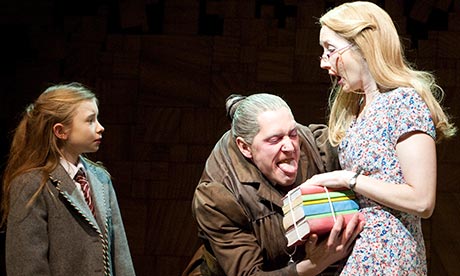
Our last and final stop for the day was the musical Matilda, something many of us were greatly looking forward to. I have been a fan of Roald Dahl's work ever since I was young, having read novels such as George's Marvelous Medicine, The Witches, The Twits and so on. Therefore, this musical was the highlight of my day. In my opinion, Matilda was very well-executed and innovative play.  The excellent cast, together with its intricately designed stage and elaborate props, such as the blackboard on which Matilda “writes” with her telekinetic powers, made the musical truly enjoyable and memorable.  The impressive, elaborate choreography and superb stage effects also contributed to a thoroughly engaging experience.
The Matilda stage set
I especially liked how the actor portrayed the character and absolute tyranny of the main antagonist, Mrs Trunchbull.  It was both comically accurate and hilarious.
SOURCE

All in all, the musical succeeded in capturing the whimsy and irreverence of Roald Dahl’s novel.

Written by Sonya, 13S15

Wednesday, 20 November 2013

Day 5, 20th November, London

      Today was the fifth day of our trip, and once again we awoke for another refreshing day in London. Even though it was a rainy day, our activities were nevertheless enriching.  After a filling breakfast, we headed off to Knightsbridge station, where one of the most famous departmental storo, Harrods, is housed.

      After a short break to take pictures at the Knightsbridge station, we were off once again heading towards St. Paul’s Church at Knightsbridge. This serene place gave all of us a peace of mind even in our short period of time spent there before heading towards our next destination, Singapore High Commission. We spent an hour at this place where we had an informative and meaningful conversation with the officers present there. As a pleasant surprise, we met our fellow Saints from the Talent Development Programme (TDP). Both groups asked questions to the officers who never failed to provide us with the right answers.
Some of us asked interesting questions such the perspective a diplomat must take when working in an international arena. The Political Officer of the Singapore High Commission stated that when working in Singapore, one might only have Singaporean perspective. However, when working in Britain, the diplomat’s perspective must be broader. A diplomat must be aware of both Singapore perspective and the international trend to find a balance and make the best decision on behalf of Singapore. Another enquired how Singapore worked with the United Kingdom in the area defense. We found out that Singapore holds a annual exercise with the British Army to strengthen our soldiers’ skills. When asked if Singapore was severely affected by the economic crisis in European Union, the officer assured us that Singapore was not severely affected. In fact, our trading with the United Kingdom has grown since.

   
   After satisfying our intellectual hunger, we left the place gratefully. Little did we know that the teachers had decided to give us a treat by allowing us to visit Harrods. We were, of course, very excited. The moment we stepped into the largest mall in the world, we were amazed to discover that the mall was, for a lack of better word, humongous. We were given an hour. We tried our best to walk around the Food Hall, which sold food products ranging from meats and seafood to sweet confectionery. 


      After a short lunch, we headed off to The National Gallery. Our breath were taken away by  a great array of paintings from old to modern art. We were able to see paintings such as Madonna of the Pinks which shows the Virgin Mary and Christ seated in a bedchamber with a view of a sunny landscape seen through a window. They hand flowers between them - pinks which are symbols of marriage - depicting the Virgin Mary as not only the Mother but the Bride of Christ. This represented divine love Virgin Mary had for her child. 


      Next, we also saw Samson and Delilah. It depicts a candlelit interior; the Philistines wait at the door, one of their number cuts Samson's hair, while an elderly woman provides extra light. In a niche behind is a statue of the goddess of love, Venus and Cupid. This painting also took my breath away with its minute details.

      After an hour and a half spent at the museum, we bought our very own postcards. After all the activities for the day, we had our dinner at the Loch Fyne Restaurant. With a three-course meal, our hunger was thoroughly satisfied with crab cakes as our appetizer, smoked chicken or salmon pasta being our main dish and finishing up with sweet desserts such as crème brulee, sorbets or cheesecakes. 


      As our final stop for the day, we were given another treat: visiting another shopping mall in Stratford, a stone throw away from where we were staying. After this visit, I was really shocked at the similarities and differences between the commercial life in London and Singapore. Even though, the shopping malls in Singapore housed many shops, they were small. Westfield, however, was relatively huge and housed a store, Primark which had a wide range of choices to choose from. This would result in so many other people wearing the same clothes as you do as opposed to the small shops in Singapore. This means that one would not want to be caught wearing the same clothes as another. Therefore, I would refrain myself from buying clothes from such huge departmental stores such as Primark. Smug as I may be, I still prefer the many little fashion outlets in Haji Lane that offer me many unique designs that can help express my individuality.


      Day 5 was a relatively short day. But it gave us a much-need reprieve to rest for the long journey to come. I look forward to my excursion to the British Library tomorrow after a good night rest.

Written by Gayatri, 13A01

Tuesday, 19 November 2013

Day 4: The Globe, Tate Modern & 'Perfect Nonsense'

Today is our fourth day in London and I think many of us would be quite glad if we never saw another baked bean for some time, sumptuous as our breakfasts are.

We had a leisurely breakfast, and headed for St Paul's in the biting cold of the windy morning. We did not tour Christopher Wren's grand cathedral, but we took many photos of it against clear blue skies. Then we walked across the Millennium Bridge - more wind, more photos, no swaying - towards The Globe.


We admired the thatched roof of the theatre, and found out from Angela our tour manager that it is the only building in London allowed one, chiefly because the straw it's made of is a great fire hazard, fuelling the spread of the Great Fire of London. We were there a bit early, so we visited the extremely comprehensive and fascinating exhibition. It featured many costumes painstakingly made to match the portraits of Elizabethan times; a full dress for the Queen is still made without zips or buttons. Instead, each part of the dress has to be laced on, which takes 90 awfully long minutes. There was also information on how the actors kept their costumes clean - they wore linen undershirts, and cleaned the costumes with urine. Fermented urine is apparently and extremely potent detergent, unless it is from an alcoholic, in which case it is completely useless.

Eventually we went to meet Simon, a Shakespearean actor, for an introduction to The Globe. He told us much of how the theatre came to be. Cuthbert and Richard Burbage had wanted to build an indoor theatre in a disused monastery in Blackfriars after the lease on the first theatre in London since the Romans ended, but were turned away, so they finally settled on an outdoor theatre in Bankside. Part of the reason for this was that being on the outskirts of city limits, they were less restricted by laws of the city. Simon also got some volunteers to enact part of The Duchess of Malfi, with hilarious results.


We also toured The Globe itself, and peeked into 'hell' (below the stage) and looked up at 'heaven' (the painted ceiling). The significance of this is that no matter where a play might be set, it was always on 'earth'. The Globe relies on natural light, and plays there don't use props. Back in Shakespeare's time, it also managed to take in 3000 people. Today it takes 1600, possibly due to health and safety regulations.


Afterward, we broke for lunch. Finding a quick, hot lunch at 1 pm in Southwark is not an easy task. Many of us ended up at Starbucks, some others at 'The Real Greek'.


Being the introvert that I am, I wasn't really looking forward to the workshop on The Duchess of Malfi. I needn't have worried at all. It was thoroughly enjoyable and liberating. Simon had us in pairs and gave us an extract of the text to act out with our partners. He gave us simple instructions on what to do when acting the scene, like pointing to ourselves when reading 'I', and telling our partners what we wanted them to respond with. It was all good and noisy fun, and I didn't think much of the meaning of his instructions till the end. Then, he explained that everything that could be interpreted of a play was in the words. Actors at The Globe changed the scene and setting through language, and the audience of the past listened for it. It seems an obvious thing, that a text is contained entirely in its words, but for me at least, it took embodiment of those words to see the obvious.

We ventured into the foyer of the Sam Wanamaker Playhouse, which was opened today. Sam Wanamaker was the American actor whose idea it was to build The Globe. The Playhouse is an indoor theatre lighted only by candles, as an indoor theatre would have been back in the 17th century. Many of us also bought copies of Shakespeare's works as souvenirs to remind us of our experience.

We admired beautiful dusk sky as we walked to the Tate Modern next door. We were given an hour to try and take in as much as we could of contemporary art. We were visibly disappointed that the Turbine Hall was closed, only to reopen next year. Of the exhibitions, I especially enjoyed the Surrealism and Minimalism ones. It's quite amazing how the different inspirations, motives and manifestations of both still managed to bring a great sense of the tranquil and serene. Many of us also enjoyed the wonderful shop, which was mecca for modern art books.


Today we had fish & chips at The Rock, Sole and Plaice. We sat outside but it was still brilliant. It was a great experience eating the piping hot fish doused in vinegar because for once I didn't have to burn my tongue to enjoy hot food in all its glory. It was made more enjoyable because the heaters perfectly balanced the cold.


When we were all happily well-fed, we walked to Duke of York's to watch 'Perfect Nonsense'. An adaptation of P.G. Wodehouse's 'The Code of the Woosters', it had all of us laughing throughout. Everyone was amazed at the speed at which the actors changed in order to play their different roles. Matthew MacFayden played a Jeeves more imperious than Stephen Fry's, but rendered a hilarious Stiffy Byng. To my initial disappointment, however, "Due to the indisposition of Stephen Mangan, at this performance the role of Bertie Wooster will be played by Edward Hancock." My dismay was unfounded because Edward Hancock played an energetic and youthful Bertie that everyone loved. We all also especially loved the Charleston all three actors danced at the end, and went away into the cold feeling very happy.

Written by Yanhui, 13A02


Day 3, 18th November, London

Today was the 3rd day of our London trip, and probably the most tiring day we had experienced up till now. Nevertheless, it was a fun and enriching day for us. In the morning, we left our hotel to take the tube from Stratford to the Covent Garden Station, where we would attend a writing workshop by the famous poet, Jacob Sam La Rose. It was our first time taking the tube, and many of us were excited yet nervous as we were travelling during the peak period, and the train station was filled with many people rushing to work.  Though I was overwhelmed by the immensity of the train station and the crowds streaming endlessly down the escalators and from the trains, I was heartened by how the English commuters were always courteous and made way for alighting passengers.  With clear instructions on how to get to Covent Garden station from our tour manager, Angela, and help from our group members, we arrived safely at our destination.


After settling down in a small and cosy room at the Covent Garden Community Centre, we finally started our writing workshop. Even though many of us were tired, Jacob’s warmth, enthusiasm and spontaneity really energized us.  As writing prose and short stories was new to me, I was worried when Jacob posed a five-minute challenge – to develop a story round a character who we had encountered during our past 2 days in London.  We claimed our own spaces within the room, and started penning down our thoughts. 


Jacob guided us in developing our short stories by sharing important elements of characterisation, and also providing many prompting and searching questions.  Some helpful questions included: what does the character want or desire; what is preventing them from getting what they want; and finally, what deeper significance or longings lay beneath these desires.  We were then thrown our next challenge to develop our character sketches into a short story, and I met with more difficulties such as starting the story, deciding how it would develop and the obstacles that lay in wait for the character.  Through this exercise, I realized that we have to really put away self-judgment and the restriction of forms when searching for ideas and creating our own stories.  I also learnt that we must always include a “human truth” in our stories, as many small and seemingly insignificant things that happen in our daily life may evoke deep emotions or alter the course of our lives.  Time flew by quickly, and we really enjoyed the whole workshop.  Jacob’s encouragements and his simple three-step writing process – “Create, Craft and Communicate” – truly helped us become more aware of how to develop our own characters, ideas and stories, and most importantly, communicate our own perspectives. 


After the workshop, we walked to the Royal Courts of Justice, and were taken on a tour by the Courts’ only official guide, Bryan Grover.  Having worked at the Courts for about 40 years, his presentation was most informative and detailed, beginning with an introduction to the history of the building.  It was built in 1873 and completed in 1882.  The building was designed by George Edmund Street, a religious man, thus explaining the statues of Jesus and Moses that line the Royal Courts.  Currently, there are about 100 courtrooms in the building, and more than 1000 staff and 104 judges in total. The Royal Courts of Justice is divided into 3 divisions: the Chancery, the Queen’s Bench, and the Family division. Each division handles different types of law cases, and it was interesting to find out that there were no criminal trials in the Royal Courts of Justice. There were only appeal cases for criminal offences, and a few prison cells located at the lower floor of the building.  We were then given a short tour around the building, and our knowledgeable and friendly guide intrigued us with tales of hauntings, such as the clock-winder who was strangled to death when his tie was caught in a huge clock hand.  In all, it was an enjoyable learning experience for me, as I not only learnt more about what the people in the Royal Courts of Justice actually do day-to-day, but also the importance of every member of the Royal Courts in ensuring its smooth running and fair hearing of trials.  


Next, we visited the British Museum, a museum that houses about 80,000 artefacts, with numerous rooms on Africa, Egypt, Japan and so on.  The exhibition that caught my eye was the display of mummies at the Ancient Egypt gallery.


I learnt that mummies were actually ground to powder and exported to Europe as medicine, and the shape of the coffins symbolized different things, such as their rank and status. The coffins for women also had drawings or paintings of classical dress, which I found really unique and exquisite.  Walking through the rooms on Europe and Asia also deepened my knowledge on the history of other parts of the world, and broadened my perspectives about the afterlife, religion, and the sharing of cultures through trade.  It was a pity that we did not have enough time to explore all the exhibits and displays in the museum, but what we got to see was enough to impress upon me the importance of preserving the past and cultivating a healthy respect for diversity and tradition.    


We had our dinner at Porters, an English pub, and had our first taste of pub food – a steak and ale pie, mashed potatoes and a custard cake.  Seeing our confusion about how to eat the pie, our kind waiter explained the ingredients and even demonstrated how to eat and enjoy the pie.  Eating the steak and ale pie was a novel experience for me, as I had not tasted this mixture of flavours before.   


We then proceeded to watch the play “War Horse” on full stomachs. “War Horse” is a play based on a novel of the same title, and tells the story from the horse’s perspective. 


Initially, I was a bit skeptical about the idea of having an animal that could not even speak as the main character, as I felt that its feelings and thoughts would not be conveyed to the audience effectively.  However, after watching the play, I was surprised that I had developed a much closer connection with Joey, the horse, in comparison with the other human characters in the play.  This was only made possible through the amazing puppetry, which truly brought the horse to life, conveying its movements and feelings so vividly that you forgot about the puppeteers.  I was especially touched by young Albert’s courageous efforts to find his horse Joey, and how love can transcend the barriers of language and war.  

Written by Michelle, 13A01